Samples for laboratory analyses may be accepted for testing in one of the following ways:
- Brought in person to the ALCT reception by the applicant or a representative authorized by him, every working day from 9:30 to 16:30 hours.
- Sent to ALCT through a courier service;
- To be received on site at the applicant’s facility by our sampler.
Required documents accompanying the samples for laboratory testing
The samples must be accompanied by the following documents:
- Application for testing (FK 7.4-1) – to be filled in separately for each sample.
- Protocol for sampling (where applicable) from the relevant control authority;
- Document for performed sampling (where applicable), in case it was not carried out by our specialists;
- Another document (optional) – letter, request, protocol, indicating the request for conducting the testing.
- Technological or other type of technical documentation in case it is applicable in the testing process.
Refusal to accept a sample for laboratory testing
Samples cannot be accepted for testing in the following cases:
- Without accompanying documents or documents with incomplete data;
- Presence of suspicion of improper transport, handling, damaged packaging, etc., concerning the reliability of the test results;
- Samples in the process of spoilage, except in cases where this is the purpose of the testing and this is reflected in the accompanying document;
- Visibly damaged integrity of the packaging or damaged seals or plumbs, when the sample is sealed by a control authority;
- Unpaid previous services for which a payment document has been sent.
Whatever the reason, including those not mentioned here, the client is notified in writing of this and the samples are returned back.
Payment for the services
Upon acceptance of samples for laboratory testing, a pro forma invoice is issued for payment. After recording of the payment made, an invoice is issued and the laboratory tests of the submitted soil samples are initiated. In case the information system has not recorded payment for your application, it is not possible to issue a test report.
For physicochemical tests:
The necessary amount of sample for analysis depends on the number and type of characteristics to be determined. In general, it is necessary to prepare about 1 kg of sample (soil).
Instruction for taking soil samples for soil analysis from areas intended for agriculture
MAIN REQUIREMENT
The soil sample must be representative for the area from which it is taken. For this purpose, it is mandatory to take an average sample from each field, regardless of its size. If the area is larger than 10 decares, an average soil sample is taken every 10 decares – the so-called elementary plot. On sloping terrains, elementary plots are formed in the upper, middle, and lower parts of the field. The collection of primary average samples is carried out under normal meteorological conditions.
Necessary tools:
Shovel, suitable (polyethylene) container for mixing the sample (bucket), polyethylene bag for about 2 kg. Do not use galvanized or brass tools, as they may contaminate the sample.
METHOD OF TAKING SOIL SAMPLES
Take the samples from fields that have not been cultivated and after the soil has dried sufficiently. The places from which the soil sample is taken should not be near a road. They should not have been fertilized with manure or mineral fertilizer immediately before taking the sample. From soils fertilized with manure, a sample can be taken no earlier than after the harvest has been collected and one vegetation period has passed, and from those fertilized with mineral fertilizer – no earlier than 1–1.5 months after the application of the fertilizer. It is considered that within the specified periods, the introduced nutrients will have been absorbed by the plants, and those remaining will already constitute part of the soil’s nutrient reserves.
The depth from which you should take the samples depends on the specificity of the crop grown:
0–30 cm, for crops with annual plants;
0–30 cm and separately 30–60 cm, for perennial plantations;
another depth – according to specific local characteristics.
Across the area, the places for the individual samples are marked. The surface of the designated places for taking the soil sample is cleaned from vegetation, plant residues, and stones. Then, with the help of a straight shovel or a special agrochemical probe, one cube of soil is removed. The thickness of the cube should correspond to the thickness of the arable layer. The individual cubes are collected on a clean surface, crushed, cleaned from small stones and roots, carefully mixed, and spread in a thin layer. From this layer, using the known diagonals and triangles, an average sample is taken, weighing 1 kg. This average sample is placed in a clean polyethylene bag or kraft paper bag. On the bag, the following is indicated: the place from which the sample was taken, depth, soil type, date of taking the sample.
With the help of a straight shovel, make a V-shaped cut at the desired depth, and put the soil from it into the bucket; in each defined section, make at least 5 individual digs, walking across the zone in an “X” or “Z” pattern.
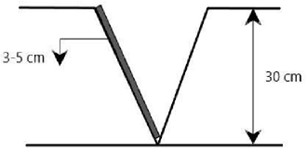
Mix well the collected soil from all digs of one zone (depth). Remove all plant residues and mechanical impurities; from the thus collected average sample, separate about 1000 g of soil, which place in a clean polyethylene bag and label the bag with the following information: location/name of the block from which the sample was formed; date of sampling and depth from which the sample was taken and possibly the indicators for which you want the analysis to be performed. Avoid placing paper notes inside the soil bags, since when in contact with the sample, they may become damp/contaminated.
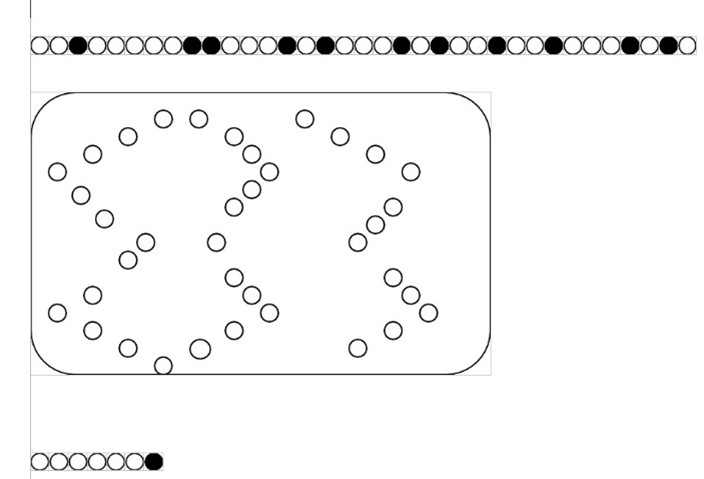
Soil samples can also be taken with the help of manual or mechanized probes from the corresponding depths. From each elementary plot, one average sample is taken, which is formed from 15–20 cores. The cores are taken along a diagonal or zigzag pattern (according to the attached schemes) within the elementary plot, avoiding uncharacteristic places in the field. The soil from all cores is collected in a suitable larger container (bucket) and mixed to homogenize it. From it, an average sample weighing 400–500 g for normal soils and 600–800 g for skeletal (stony) soils is taken and placed in a clean labeled polyethylene bag (for each depth in a separate bag).
SCHEMES FOR COLLECTING SOIL SAMPLES FROM AN ELEMENTARY PLOT